God & Violence
Options for Interpreting Old Testament Violence

For millennia, Christians have wrestled with how to interpret violent intentions and actions in the Bible that are depicted as God-approved or God-orchestrated. (There’s also violent imagery, but that’s a topic for another day.). These may be conducted by God directly, or through spiritual or human agents. For many interpreters, violence poses a stark contrast to the God revealed in Jesus, who embodied sacrificial, enemy-embracing love (Matt 5:43-48). Whilst there are sporadic violent episodes in the New Testament (NT) itself that could be linked to God (Ananias & Sapphira’s death, Herod Agrippa I’s death, etc.), most of the passages in question are found in the Old Testament. Three notable passages, to be considered below, are the flood (Gen 6-8), the Canaanite Conquest (Josh 1-12) and the Israelite (2 Kgs 17:5-8) and Judahite exiles (2 Kgs 24:10-25:30).
There is no consensus among Christians about how to read these sorts of passages; different traditions employ varied readings: historical, cultural, allegorical, theological, etc., or a combination of these.
In thinking about different approaches to this topic, four pithy options come to mind when considering violent passages:
The violence (rightly) happened as described.
The violence (sadly) happened as described.
The violence didn’t (remotely) happen as described.
The violence didn’t (exactly) happen as described.
I’ll briefly discuss the first three, before giving a couple options for addressing Option 4, which I deem to be the most flexible option. I’ll also directly address how these approaches might conceive of a loving God.
1. The violence (rightly) happened as described.
This approach would strongly emphasise God’s justice. He rightly has to punish sin and, as a holy God, it is God’s remit to decide the means and severity of that punishment. Consequently:
God sent the flood in response to rampant human violence (Gen 6:11). Creation was almost entirely lost, except for one righteous family. So God justly washed the world clean and initiated a second creation, beginning not with Human and Life (Adam and Eve), but Noah and his family, whose messianic descendant would one day die for the world.
God commanded the Israelites to invade Canaan, because the inhabitants were supremely wicked or had morally “gone past a point of no return.”1 For the sake of God’s salvation plan, the Canaanites had to be exterminated to make room for Israel, through which the Messiah would eventually come.
God handed over Israel and Judah to pagan powers, because of their sin (idolatry, sexual immorality, and violence). The terms of the covenant had stipulated that these sins would result in exile, but the people refused to listen; they had repeated the sin of the Canaanites and so had to be justly “vomited out” (cf. Lev 18:24-30).
Similar logic of just punishment for sin could apply to the Ten Plagues and God’s judgements against various Israelites.
2. The violence (sadly) happened as described.
This interpretative approach would recognise the discomfort that violent passages produce in readers and potentially aim to emphasise the grief with which God punishes, or the limited timeframe within which these actions occurred. So, maintaining an emphasis on God’s justice, but trying to bring love more into the analysis.
God brought the flood not out of anger, but out of grief at the multiplication of human violence, and was sorry for what these created beings had become (Gen 6:6-7). Though the violence still happens as described, God appears softer, potentially more loving, and the flood is shrouded with regret.
God endorsed the Canaanite Conquest, but this was a limited geographical region, a set period of time (about one generation) and a specific step in God’s bigger salvation plan, which required Israel’s establishment in the land. He had made a covenant with Israel, which would one day bless the whole world (Gen 12:1-3), but temporarily included violence against Israel’s opponents.
God repeatedly and patiently warned Israel & Judah of their sin, leading up to the exile, just as he’d had patience with the Canaanites (Gen 15:16). He loved his people, describing them as his bride (cf. Hosea). When they turned back to him, he delayed punishment: e.g. Ahab (1 Kgs 21:29) and Josiah (2 Kgs 22:15-20). But eventually sin became too rampant, their uniqueness as his people was too tarnished, meaning God had to exile them for the sake of his plan to bring about the Messiah.
Similar emphasis on God’s grief in punishing, or his patience in delaying punishment, or his love and commitment to Israel, specifically, could be highlighted in other passages.
3. The violence didn’t (remotely) happen as described.
Some Christian scholars can apply this reading to much of the Old Testament, though this may be because, in applying historical-critical methods, they conclude that there is a lack of external evidence for many of the events so described: e.g. the flood, the exodus, the Canaanite Conquest. Alternatively, they question the possibility that these events could even occur, such as flooding the whole earth in enough water to cover Mount Everest. (Many Christians would label these scholars as “liberal,” which I’d understand to essentially mean that these scholars’ understanding of the Bible is dramatically different from their own.)
Other Christian scholars might arrive at similar conclusions for various passages, but for different reasons. Comparing Old Testament passages with other Ancient Near Eastern texts has sometimes found a high correspondence in language and outlook, though there are some stark differences. Some of the covenant curses, for instance, are remarkably similar to an Assyrian text that stipulated punishments against those who opposed King Esarhaddon’s succession plans:2
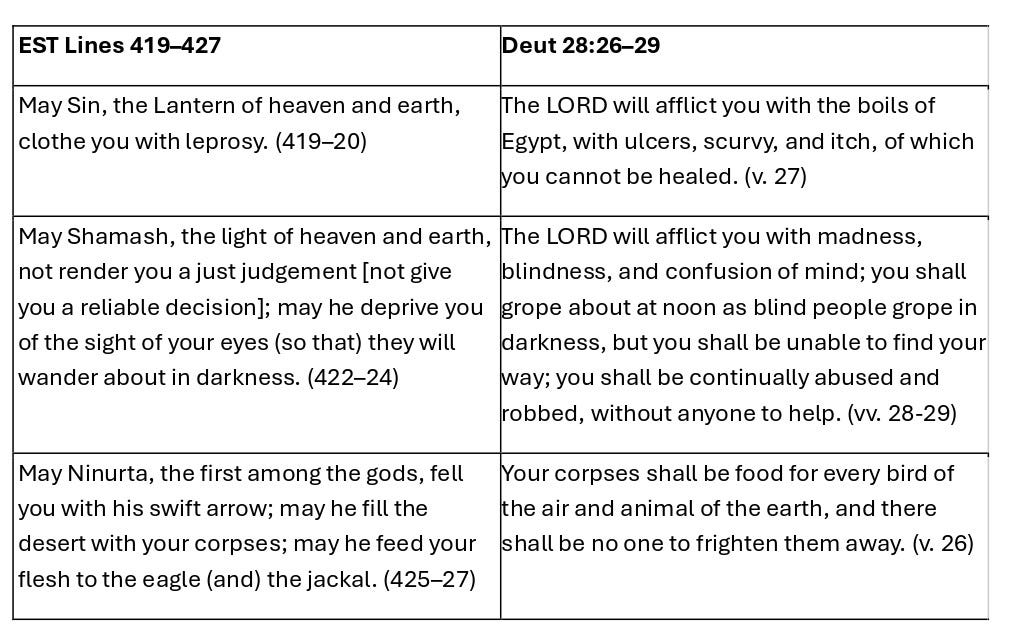
Additionally, it’s widely recognised that a narrative involving a large body of water (a flood or sea) is prevalent throughout other texts of that era.3 Consequently, some scholars question the historicity of the Genesis account, instead understanding the passage as reworked material from other sources, but within the theological agenda of the Old Testament.
Whether a Christian would consider this a valid approach will likely come down to their doctrine of Scripture. But this is one way that some Christian interpreters vindicate God from committing violence. That being said, there is still the depiction of God being violent in these passages that would have to be explained theologically.
4. The violence didn’t (exactly) happen as described.
Interpreters taking this approach may have a double agenda: to uphold a high view of Scripture, whilst also looking to cultural, theological, or literary contexts to help reconcile divine violence and divine love. Two aims can often be seen:
reduce the severity of the violence or
reduce God’s complicity in the violence
4.1 Reducing the Severity
There is a wide range of strategies that could fit within this approach. A selection of arguments concerning our three passages are:
The scale of the flood was smaller than regularly assumed. Many English translations render the passage as saying the waters covered “the whole [kōl] earth [ʾerets]” (Gen 8:9). Yet, this phrase is regularly used elsewhere to refer to a specific geographical region and not the entire globe (e.g. Gen 13:9; 41:57; 1 Kgs 10:24). Similarly, God destroying “all [kōl] flesh [bāśār]” (Gen 6:13), doesn’t have to mean the entire human race, as the phrase clearly cannot mean this elsewhere (e.g. Isa 40:5; Ezek 20:48; Joel 2:28). Finally, from the literary context, it’s clear that in saying that “the whole earth” descended from Noah’s sons (Gen 9:19), the text is referring to the peoples who lived in the Ancient Near East (Gen 10:1-32), not the Americas, Western Europe, Australasia, etc.4 Consequently, it could be argued that the severity of the violence is significantly reduced, because the scale of the flood was smaller than English translations suggest.
God explicitly commands the Israelites to kill all the Canaanites, to leave none alive, or to “utterly destroy them [herem]” (Deut 7:1-2; 20:16-18). The narrative can then echo this language, like how the Israelites “utterly destroyed [herem]” the people living in the towns of Hebron and Debir (Josh 10:36-39). However, it’s clear that not all were actually killed, as Canaanite inhabitants from those towns appear in a later narrative (Josh 15:13-15). Another example is Gezer (Josh 10:33; Judg 1:29). Many scholars explain this discrepancy by interpreting the command to herem as ancient battle propaganda, or a common cultural practice of using intentional exaggeration, which reflects the reality of the Bible as a library of ancient texts. So, the severity of the violence that God commanded is less than first appears.5
The Babylonian exile of Judah is often considered to involved the majority of the population, however, a much smaller number was actually removed from the land. One figure counts 4,600 exiles (Jer 52:28), whilst another 10,000 (2 Kgs 24:14). These were selected from the Judahite elite: the royal family, military leaders, skilled workers, priests, and administrators (2 Kgs 24:14–16; Ezek 1:1-3). Left behind were “the poorest people of the land,” tasked with maintaining agriculture (2 Kgs 24:14; 25:12; Jer 39:10).6 Based on these passages, the severity of the violence that God brings on his people would be lessened.
Whilst these arguments all seek to reduce the severity of the violence God causes, commands, or allows, God’s complicity with violence is not erased.
4.2 Reducing God’s Complicity
Various theological or allegorical (metaphorical) readings of the Old Testament have been employed through the centuries, which are especially prominent in the Orthodox tradition, to distance God from concrete violent actions.
The Protestant theologian and pastor Greg Boyd has an interesting perspective on the question of God’s love and violence in the Bible. He utilises a theological reading, but also makes reference to cultural and literary contexts. His thesis is fully developed in Crucifixion of the Warrior God (two weighty tomes),7 but he has released a popular-level edition (Cross-Vision),8 and written various sermons and blog posts.9
Boyd’s arguments are multi-layered, but some of his key points are:
Jesus is the supreme revelation of who God is (John 14:9; Heb 1:3) and the most climactic point for this revelation is Jesus crucified (1 Cor 2:2).
The cross reveals God to be self-sacrificial, co-suffering, enemy-embracing love. God would rather die for God’s enemies than kill them: God is not violent.
Yet, paradoxically, on the cross, Jesus presents as something which he is not: a condemned, guilty criminal.
God the Father wasn’t punishing Jesus on the cross, but handing him over to destructive spiritual and human agents to suffer the consequences for humanity’s sin (Acts 2:23).
Boyd ties these observations together to create “the Cruciform Hermeneutic”: God is not violent, but God is presented as violent in the Bible. Consequently, two primary options could be happening in any passage:
God is graciously accommodating the views of the biblical writers, who were deeply situated in their cultural setting, and allowing them to portray God as violent.
God allows judgement to happen, but this is through handing people over to destructive agents (human and/or spiritual), opposed to God committing violence himself. The language of “handing over” is common (2 Chr 36:17; Ezra 9:7), but Boyd prefers to emphasise the language of God hiding his face (Deut 31:17; Isa 1:15; Mic 3:4), which he interprets as the withdrawal of God’s protective presence.
Consequently, passages where God is depicted as violent need to be reread in light of the revelation of Jesus and alternative interpretations need to be sought in line with one of the two options above.
Some notable interpretations:
The floodwaters are understood by biblical writers as part of anti-creation forces (chaos) that seek to destroy the world (Ps 77:16), and return it to a decreased state (Gen 1:2). Yet, God restrained the waters above and below (Gen 1:6-8), making a boundary they could not cross (Ps 104:7-9; Prov 8:29; Job 38:8-11). So, when all of humanity (minus Noah’s family) is in rebellion against God and the world is already corrupted through violence (Gen 6:11), God withdraws his protective presence and the boundary holding back the waters, allowing the destructive waters to undo creation. God’s specific involvement, then, is actually sending his Spirit and forming a new creation (Gen 8).
God initially described Israel’s occupation of Canaan as something that God would slowly bring about through (seemingly) non-violent means (Exod 23:27-30), but later in the narrative, the Israelites present God as commanding a militaristic invasion (Deut 7:1-2). God didn’t want them to use violence, but Israel was typical of warmongering peoples of that era, and so God graciously works with them and allows Israel to present God as endorsing their violence.
The exile involved violent pagan nations conquering God’s people as the method of judgement (Isa 10:5-6; Jer 25:8-9). Boyd interprets this not as God being violent, but as God withdrawing his protective presence in response to Israel/Judah rejecting him: God hid his face from both Israel (Isa 8:17) and Judah (Jer 33:5). The pagan nations are themselves violent and bent on destroying others. Due to their desire for violence, God will bring judgement against them (Isa 10:5-12; Jer 25:12-14).
Finally, to note: Boyd strongly emphasises the spiritual realm, which is often represented throughout the Bible, and attributes lots of violence to other spiritual forces when God brings judgement. For example, during the Passover, God has to actively prevent “the destroyer” from targeting those who apply the lamb blood to their door frames (Exod 12:23). Similarly, in response to David taking a census of Israel, God sends a “pestilence” as judgement, but God then had to restrain the destroying angel when it tried to destroy Jerusalem (2 Sam 24:15-17). Building on these observations, Boyd seeks to insert violent spiritual beings into other passages where God conducts violence (e.g. Num 16:31-33; 2 Sam 6:6-7).
Boyd’s theological reading attempts to reread passages in the Bible where God appears violent, in order to vindicate God as love, as demonstrated through the cross. However, many Christians may object to his interpretations, as they could conflict with their doctrine of Scripture.
Final Thoughts
Christians have debated violence in the Bible for millennia and continue to offer alternative reading strategies for how to wrestle with the God of love who is also committed to justice. The four main options above are not necessarily mutually exclusive, but Christians might use them together or apply different strategies to different passages.
Hopefully, we can all work together through healthy dialogue to make these strategies as robust as they can be, whilst also respecting which strategy we as individuals may find the most persuasive for any given passage.
Paul Copan (2011), Is God a Moral Monster? Making Sense of the Old Testament God. Copan also calls the Canaanites “corrupted beyond moral repair” in (2008), When God Goes to Starbucks, p. 142
EST is Esarhaddon’s Succession Treaties. Table is from Karen R. Keen (2022), The Word of a Humble God: The Origins, Inspiration, and Interpretation of Scripture, p. 40
Pete Enns discusses the similarities between Gen 6-9, the Atrahasis Epic and the Gilgamesh Epic: https://biologos.org/articles/gilgamesh-atrahasis-and-the-flood
For more references and arguments for a local-regional flood, see Michael Heiser: https://drmsh.com/argue-biblical-text-local-regional-flood-instead-global-flood/
For more references and arguments about the Canaanite Conquest, see this helpful blog by Bible Project: https://bibleproject.com/articles/judgement-cruelty-conquering-promised-land/
For more references and arguments for a smaller-scale exile, see Joel Edmund Anderson’s review of Iain Provan, V. Philips Long, and Tremper Longman (2003), A Biblical History of Israel: https://www.joeledmundanderson.com/a-biblical-history-of-israel-by-iain-provan-an-extended-book-analysis-part-11-the-exilic-and-post-exilic-period/?utm_source=chatgpt.com
Greg Boyd (2017), Crucifixion of the Warrior God: Interpreting the Old Testament’s Violent Portraits of God in Light of the Cross, Vols 1 & 2.
Greg Boyd (2017), Cross Vision: How the Crucifixion of Jesus Makes Sense of Old Testament Violence.
For instance, see: https://reknew.org/2017/03/overview-crucifixion-warrior-god/